LEADERSHIP IN PRACTICE | SUPERINTENDENT SPOTLIGHT
A Saskatchewan superintendent on what two decades in one division teach you, why consistent support teams matter more than programs, and how he's approaching AI as a mindset shift rather than a threat.
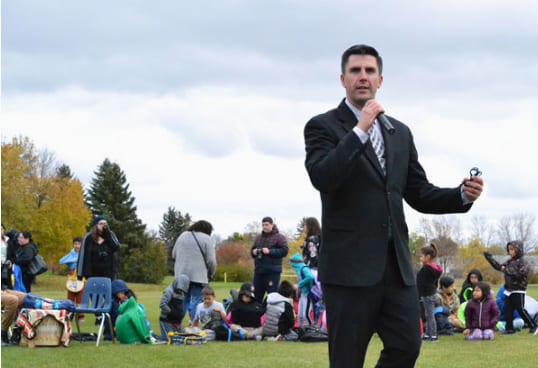
FEATURING Jeff Court, Superintendent of Schools, Saskatchewan Rivers Public School Division
A majority of education leaders tend to move around from district to district. It's almost a given. So when you meet someone who's spent 21 years in a single division, going from teacher to vice principal to principal, then from principal on assignment to superintendent, and genuinely seems energized by the work, you pay attention.
Jeff Court is that person.
He's been at Saskatchewan Rivers Public School Division for over 20 years. He's taught in its classrooms, led its rural schools, navigated a global pandemic from behind a principal's desk at a 1,800-student urban high school, and now oversees clusters of 5 to 9 schools across the division as superintendent. That kind of continuity doesn't happen by accident. It's a choice. And understanding why he made it and what it built gets at something a lot of leadership conversations miss.
What Depth Looks Like in a Career
Jeff's path didn't follow a straight line upward. It curved, doubled back, went rural, then urban, and then back again.
He started at Carlton Comprehensive High School as a teacher, moved into the role of vice-principal, then stepped away to lead Birch Hills Public School, a rural K-12 community school that was, as he puts it, the hub of its entire community. Four years there changed how he thought about relationships and local context in a way that no leadership course can replicate.
"This K–12 experience broadened my expertise into elementary education, grounded my belief in relationship-driven school culture, and taught me how to leverage community partnerships to support students."
Then he went back to Carlton as the principal of a school operating at a completely different scale.
The contrast between the close-knit community of Birch Hills and the scale of Carlton is probably why Jeff talks about leadership the way he does. He doesn't separate the relational from the operational. He treats them as the same thing. District-level work, in his view, only functions if you understand how it will actually land in classrooms and in hallways.
"When instructional context is overlooked, even well-intended decisions can create barriers rather than support."
That's not merely an empty statement. It's from someone who observed it unfold, from both perspectives.
District leadership in Saskatchewan right now also means navigating something harder to systematize: public trust. Jeff is candid about it. There's been genuine unrest in some communities toward public education.
Polarizing viewpoints that don't have clean answers. His response isn't to get defensive or retreat behind policy. He coaches administrators to go deeper into their communities. To reflect, connect, collaborate, and provide clarity. Community members come alongside schools when leaders do the work of actually knowing who they're serving. That takes time. It takes presence. And it starts with administrators who genuinely understand the communities they lead.
The Problem Being Overlooked
When Jeff returned to Carlton as principal, he came back to a school of 1,800 students, an enormous staff, and a student support model that wasn't really a model at all.
Support staff was reassigned each year. Administrators rotated. And as a result, families and students never got the continuity they needed to trust the system.
So they rebuilt it.
From Fragmented to Family-Centred
Instead of assigning support arbitrarily year by year, Carlton created dedicated support teams that stayed with families throughout their entire high school journey. The same team, the same relationships for four years.
On paper, the shift wasn’t dramatic. But in practice? It changed the quality of every difficult conversation the school needed to have with families. It built the kind of trust where parents actually called back, where students felt like someone actually knew them.
The graduation rates improved, and that mattered. But Jeff talks about it as a byproduct, not the goal. The goal was belonging and making sure students felt deeply connected to their school. The numbers followed.
The Infrastructure Behind the Culture
Somewhere in the first years as superintendent, Jeff also turned his attention to something less visible: how the division actually operated behind the scenes.
HR processes. Leave tracking. Seniority records. Most senior leaders either accept or resent the administrative infrastructure that they inherit. Jeff chose the third option of fixing it.
By bringing technology in to automate routine, manual tasks, his team didn't just make things more efficient. They did something more interesting: they gave people their time back. The administrative staff who used to spend hours on data entry now had the capacity for the conversations that actually required a human. The HR function became less about processing and more about supporting.
"Human connection remains the priority, and employees feel deeply valued and supported in every face-to-face interaction."
That is easy to say. Much more difficult to actually engineer. Jeff engineered it by first ensuring that the boring parts worked efficiently.
See Your People. Let Them See You.
Jeff spends significant time being physically present with teachers and students. Not just for formal visits or when something's gone wrong, but regularly and intentionally. His view is that showing up consistently and focusing on people's strengths rather than their gaps creates conditions where problems are caught early, before they become crises.
"True effectiveness comes from visibility. Ensuring that you see your people and they see you."
When leaders show up like that, staff feel noticed, trust is established, and individuals are inspired to go the extra mile for their schools.
He also evaluates school culture through the eyes of all stakeholders. Students, staff, and families see something different, and all of it matters. That information feeds back into the organizational systems he's constantly refining. The goal is leadership that scales without losing its relational core.
And the key skill for educators today, he says, is leadership agility: the ability to be responsive and clear without losing direction, along with real relational modeling. Not just discussing relationships as a value. Actually doing what it takes to show up for people, every day, at every level of the system.
AI Is An Opportunity, Not A Threat
This is where many district leaders get cautious. Jeff doesn't.
He calls AI adoption "fundamentally a mindset opportunity rather than a point of concern." Not reckless enthusiasm, and he's specific about what the goal is: using AI to streamline processes, enhance pedagogy, and bring lived experiences to the forefront of teaching and learning.
What's interesting is how naturally this follows from everything else he's done. He's already demonstrated, through the Carlton student support redesign and the HR modernization, that he knows how to distinguish between the work that should be systematized and the work that has to stay human. That discernment is exactly what smart AI adoption requires.
Most schools have no problem with the introduction of AI. The thing is, no one really knows what it replaces and what it’s shielding. Jeff has been thinking about that distinction his whole career. He just didn’t call it AI.
What Drives Him After Two Decades In the Same Division
The thing about Jeff that stands out most is not the 21 years, the graduation rate improvements, or the HR overhaul.
To him, these aren’t the rewarding moments. It’s the small instances of recognition and gratitude that show the impact of his work.
He talks about running into former students at the grocery store and bumping into parents at the gas station. People saying thank you for something he did years ago that he might not even remember doing.
"Fulfillment does not stem from a single, isolated achievement. It is found in the value of everyday interactions."
For someone who's built and rebuilt systems at every level of a large public school division, that's a telling answer. It means the systems were never the point. The systems were just how you cultivate relationships.
His Advice to Anyone Coming Up Behind Him
Jeff's guidance for aspiring leaders boils down to four, deceptively simple ideas.
Know yourself first; identify your core values and recognize how they actively shape and impact your leadership of others.
Build leaders, not followers. Intentionally cultivate and develop other leaders within your organization.
Stay proactive, because reactive leadership costs everyone more in the long run.
And always, always stay student-centered, especially when it gets uncomfortable.
"Clarity is kind. People will ultimately respect you for a transparent, student-first approach."
That's not complicated at all. It's just difficult.
What This Story Is Really About
Jeff Court’s career doesn’t make the biggest headlines. He hasn't been around the high-profile districts, reinventing education on a stage. Instead, he did something quieter and in some ways harder: he stayed. He went deep and built things that would outlast him.
It’s a kind of leadership that is hard to spot because it doesn't draw attention to itself, but what schools really run on. The kind that creates the conditions for students to belong. For teachers to do their best work. For communities to trust their schools again.
Twenty-one years in and, by all accounts, still curious.
Why TomoClub Is Sharing This Story
At TomoClub, we believe the future of education is shaped inside schools by leaders who go deep, stay long enough to see things through, and resist the temptation to move on before the work is done.
Jeff Court’s work at Saskatchewan Rivers is the kind of leadership that often goes unrecognized. It’s firm, grounded, and in for the long game. The kind that understands that you build the systems and relationships that enable improvement before you improve outcomes. And that’s the sort of leadership education needs more of right now.