Most declining school enrollment is demographic. A third of it isn't. Here's what high-performing districts miss when they treat every student loss as inevitable.
Walk into a school board meeting in Palo Alto, California, or Montclair, New Jersey, and you will hear a familiar, anxious conversation: "why are our schools struggling to retain students?", "why are the enrollments continuously falling?"
Even highly affluent school districts that draw families in with pristine facilities, exceptional state test scores, and enviable resources have been facing the same problem, a recent analysis in the New York Times reveals. They are losing families who live just minutes down the road.
The question is, why?
If top-tier academic ratings were the only factor keeping classrooms full, high-performing districts would be entirely immune to the current crisis. But they aren't. Traditional demographic data can account for the loss to an extent, but it cannot answer a critical question that often escapes the reasoning radar – of the families public schools are losing, which ones could they have kept?
Today's blog will help you understand what districts can realistically focus on, and do, to build sustainable solutions against an enrollment decline that seems inevitable.
1. The story everyone is telling (and why it is right)
When administrators review their shrinking rosters, the default explanation points directly to demography. And that narrative is heavily supported by the numbers. The U.S. fertility rate peaked in 2007 and has fallen by roughly 24 percent since then. As the children born during that peak graduate from high school, there are simply fewer five-year-olds replacing them.
The projections reflect this shift. Between 2019 and 2024, K-12 enrollments across 40 states dropped by nearly 3.8%, a loss of about 1.5 million students. Looking ahead, the National Center for Education Statistics (NCES) forecasts an additional loss of 2.6 million students nationwide by 2031.
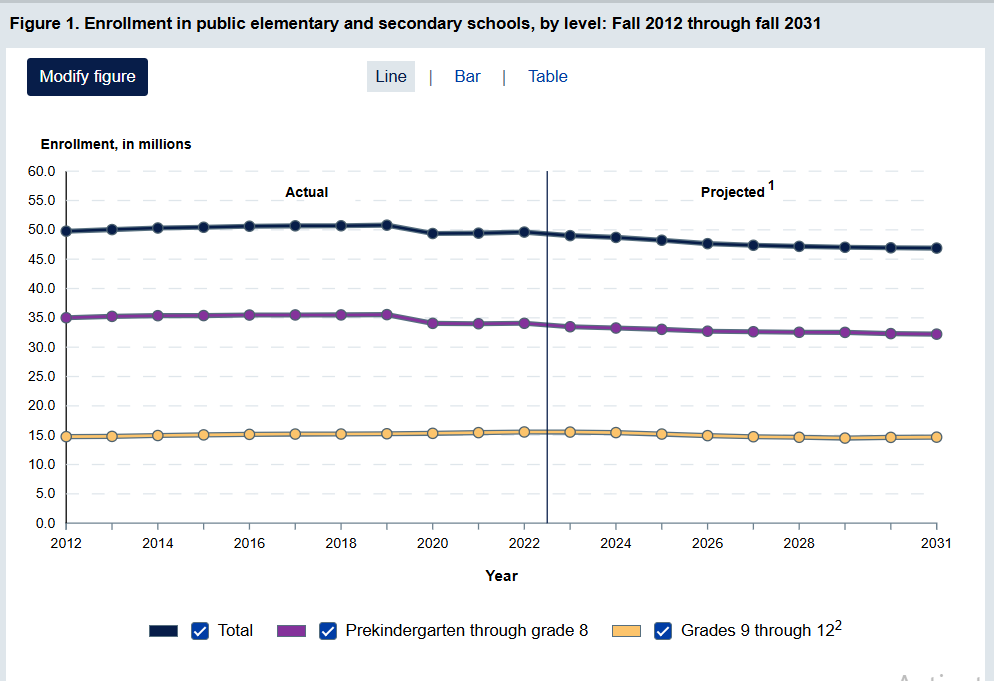
Enrollment in public elementary and secondary schools, 2012–2030. Source: National Center for Education Statistics, Annual Report, Public School Enrollment, May 2024.
Therefore, when analyzing declining enrollments, treating the phenomenon as a demographic reality is a completely rational starting point, because demography sets the total size of the student pool.
That is why the sector has spent five years reading a demographic story so well-evidenced that it feels like weather – something to prepare for, but impossible to change.
However, treating every lost student as a demographic inevitability makes the controllable portion of declining school enrollment completely invisible.
2. The part of the decline nobody can explain
The demographic story is accurate, but it is incomplete. While lower birth rates account for the majority of the downturn, millions of departures defy that explanation.
Research from Stanford University economist Thomas Dee found that shifts to private schools or homeschooling fail to account for about one-third of the 1.2 million students who left the public system immediately following the pandemic.
A comprehensive report from the Brookings Institution measures the gap from a different direction. Comparing Census population counts against every federal school enrollment file, it found that roughly 2.05 million additional students were newly missing from both public and private records between 2019-20 and 2021-22, a 450% jump, with traditional public schools accounting for 1.72 million of that total.
While pointing to slightly different statistics, both Dee's analysis and the Brookings report highlight that there is a pool of students – one that has grown to a considerable size post-pandemic – which remains unaccounted for.
Some of this gap, however, is diverted to other pathways, like charter schools and virtual schools. A Bellwether analysis reveals that charter enrollment grew 64%, roughly 1.5 million students, between 2012 and 2022, while district enrollment fell 3%. Virtual school enrollment nearly doubled after 2020 and has stayed elevated since. Beyond those, families are exploring micro-schools, specialized charters, and dynamic alternative models, many of which are too new or too small to appear cleanly in federal data at all.
It is completely understandable why leadership teams default to treating declining enrollment as a passive symptom of macro-economics. State-by-state birth-rate drops have created intense pressure across the country. Treating demographic headwinds as an unwinnable fate, however, overlooks a massive opportunity.
The problem of declining school enrollment, thus, exists in two halves. Most of the decline comes from population change, and no district can do anything about that. But the rest is different. Those families did not leave because the school's results dropped. They left because they were not sure the school was preparing their children for the world those children are growing into.
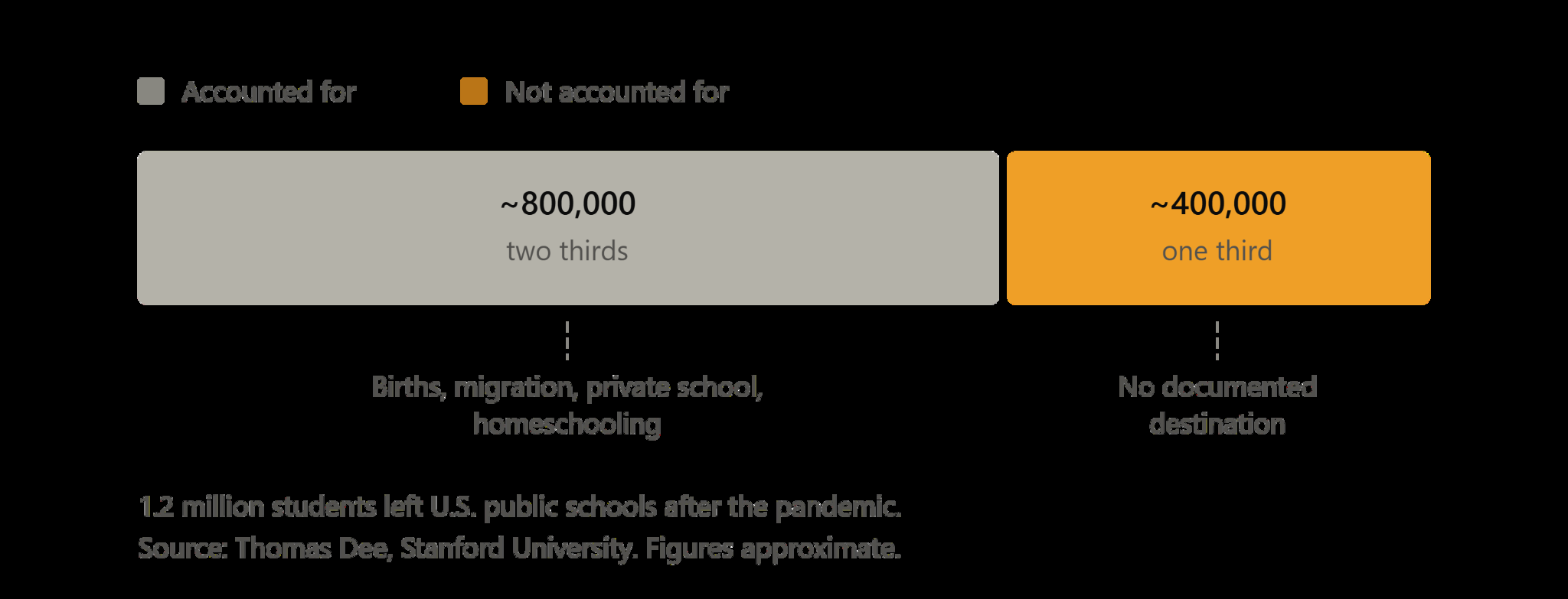
Of the 1.2 million students who left U.S. public schools after the pandemic, roughly one-third has no documented destination. Source: Thomas Dee, Stanford University.
What the unexplained share means for your district
For a single school district, the aggregate national data is less important than the local reality. If a district loses 300 students, and demography accounts for 200 of them, the remaining 100 represent an active choice to leave. Those families haven't aged out of the system, nor have they necessarily moved across state lines. They have simply chosen a different educational path.
When leadership attributes all 300 losses to birth rates, they stop asking how to retain the 100 families they actually had the power to keep.
3. Great schools are being measured on the wrong thing
For decades, families used standardized test scores and facility upgrades as the primary proxies to determine if a building was a "good school." Consequently, districts built their retention and marketing strategies around these metrics.
Today, the criteria have fundamentally changed. Parents are acutely aware of the rapid technological advancements reshaping the economy. They watch artificial intelligence transform workplace expectations and worry about their children's ability to adapt. The core question has shifted from "Is this a highly-rated school?" to "Will this school prepare my child for the world they are entering?"
No public metric or state report card answers that question. If a district maintains strong test scores but relies on rigid instruction and outdated technology policies, parents notice the disconnect.
They evaluate a future-ready school not by its state ranking, but by the relevance of its daily instruction. When a school fails to bridge that gap, the decline may multiply as families seek out environments that prioritize adaptability over rote memorization.
4. What a parent actually seeks
For decades, public schools relied on a predictable playbook to keep classrooms full – publish high graduation rates, showcase a new STEM lab, and highlight state test rankings.
Today, that playbook falls flat. When examining why parents are leaving public schools, administrators need to look past traditional rating sites and pay attention to how parent perception of school quality is actually formed at the dinner table, when their child tells them what they learnt in school today.
Parents today carry deep anxieties about an unpredictable economic landscape. They watch generative artificial intelligence transform workplace expectations in real-time. They are increasingly aware that rote memorization will not secure their child's future. Instead, what parents look for in a school centers entirely on adaptability.
Families want to see evidence that their children are developing cognitive flexibility, critical interpretation skills, and the emotional intelligence required to collaborate effectively. They evaluate daily learning experiences based on the work their child brings home. Are teachers asking students to passively absorb information, or are they guiding them to analyze complex questions and engage with technology responsibly? A district that feels bureaucratic, slow to communicate, or resistant to modern learning strategies sends a subtle but powerful signal that its classrooms are equally static.
This realization is when parents begin exploring charter networks, micro-schools, or alternative models that promise a more agile learning environment.
5. What a district can control
If declining school enrollment is heavily influenced by how families view classroom relevance, district leaders have direct agency to turn those numbers around. Reversing the trend requires a school differentiation strategy focused on the daily instructional experience.
Here are four actionable moves a district can make to retain families:
1. Audit your quality signals
Look closely at what your district communicates during open houses and community outreach. What parents look for in a school has evolved. Stop relying exclusively on legacy metrics like test rankings. Demonstrate exactly how your classrooms cultivate critical thinking, purposeful questioning, and real-world problem-solving that make your students future-ready.
2. Invest directly in teacher capacity
The single most important factor that districts often overlook is the one which shapes the student experience every day: teacher capacity.
Parent retention decisions happen when they read the assignments coming home, or when a teacher answers a question about how digital tools are used in the classroom. If a child describes disengaged lectures or confusion around how new tools are used, parents draw immediate conclusions about the school's trajectory.
When public schools struggle to equip educators with the training and resources needed for modern learning environments, the classroom experience suffers, and families quietly file transfer requests. Conversely, when teachers are supported with clear communication and actionable frameworks that foster true future-readiness, students bring that dynamic energy home.
Teacher retention and enrollment are deeply connected; a supported, capable educator is the most powerful retention strategy a district possesses.
3. Replace defensive PR with classroom transparency
Move beyond generic promotional banners designed for recruitment. Focus on retention through visibility. A Learning Heroes report shows how proactive, persistent and consistent communication with families about academics can lead to better outcomes for both parents and students.
Show parents how educators guide students to analyze complex questions, work through group dynamics, and engage with technology. Direct, transparent communication about academic progress and modern skill development builds immediate trust.
4. Track the exit trends and adapt
Examine your district's internal enrollment data to identify where the unexplained losses are happening. Are families leaving during the middle school transition? Are specific grade bands seeing sudden shifts? Use proactive family feedback to identify the instructional pain points driving those departures before they become permanent.
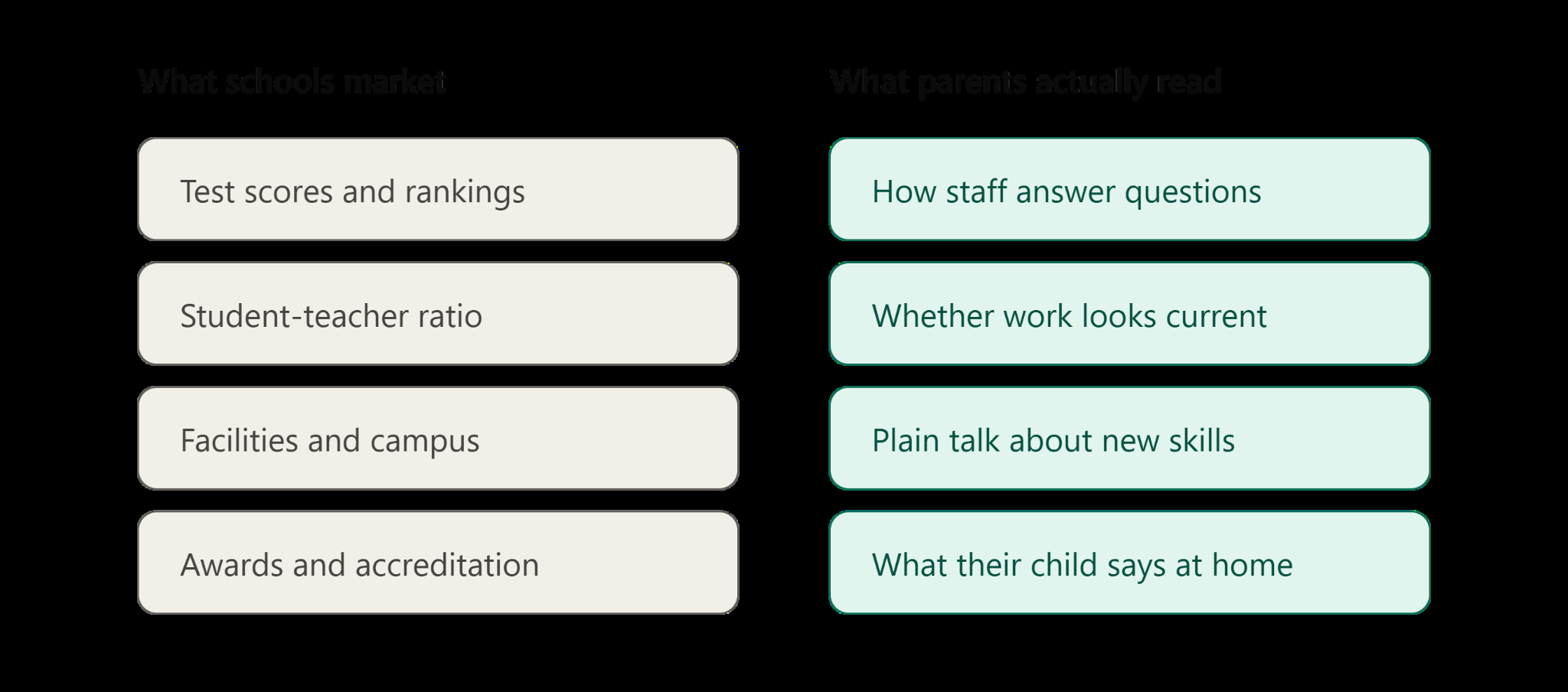
Traditional school enrollment marketing signals against the local, everyday evidence families actually use to judge a school.
Ultimately, no single school can stop a national demographic trend. But districts have immense control over the quality, relevance, and agility of their classrooms. By giving teachers the interactive frameworks and support they need to foster true future-readiness, districts can transform everyday instruction into their strongest defense against enrollment loss.
To read more such pieces about the latest developments in the world of education, and to learn more about how engaging learning frameworks and modern skill development can keep your classrooms vibrant, bring TomoClub to your school. Book a call →
Frequently Asked Questions
Why is school enrollment declining in 2026?
A significant portion of declining school enrollment stems from lower birth rates and shifting population migration. However, research indicates that roughly one-third of the enrollment loss is unaccounted for and may include families actively choosing alternative education options due to evolving expectations around school culture and instructional quality.
Can a school district do anything about declining enrollment?
Yes. While schools cannot change macro demographic trends, they can actively manage their retention efforts. Figuring out how to improve school enrollment requires focusing directly on the classroom experience, building teacher capacity, and ensuring students are learning the adaptable, modern skills that families value the most in today's world.
What are families looking for in a school now?
Families expect schools to provide more than good facilities and high test scores. They are looking for evidence that their children are developing cognitive flexibility, critical thinking, and the emotional intelligence necessary to succeed in an unpredictable, AI-driven economy.