Teaching students to use AI takes more than tool access. Here are the five foundational skills students need to evaluate, guide, and learn alongside AI.
"…And General George Washington passionately led the Continental Army against the British forces in the Battle of Gettysburg, one of the bloodiest affairs of the American Revolution."
Wait. What? Do you also fear landing on such absurd information as you go through the latest, much sophisticated essay that your fifth grade student turned in? Don't worry, you are not alone.
A nationally representative poll (NPR/Ipsos) of 545 educators expressed a worry that AI's impact on education would be even greater than that of the internet or computers, and worry about it eroding critical thinking skills.
But this is the age of AI, and it is here to stay. With technology evolving rapidly every day and new tools flooding the market, it is easy to get overwhelmed. The solution, however, is not to worry if the student can even think without AI, or worse, mandating a strict no-AI policy.
It is to teach the student to think with AI. It is to give them hands-on examples and tasks that develop communication, adaptation and judgement when working with AI. Because today it is a fallacy in an assignment, tomorrow it'll be a real-life situation with higher stakes at their job. Any tool that they master today will completely change tomorrow, but a set of skills that make them critically sharp is what will stay.
Our job as educators and school leaders, therefore, is to build a cohort of students who are curious, capable of problem-solving, digitally and ethically sound, and adaptable.
Today, we talk of five important skills that will equip your students to thrive in the age of AI. These are neither purely technical skills nor purely "human" skills, but a balance of both, just like the future.
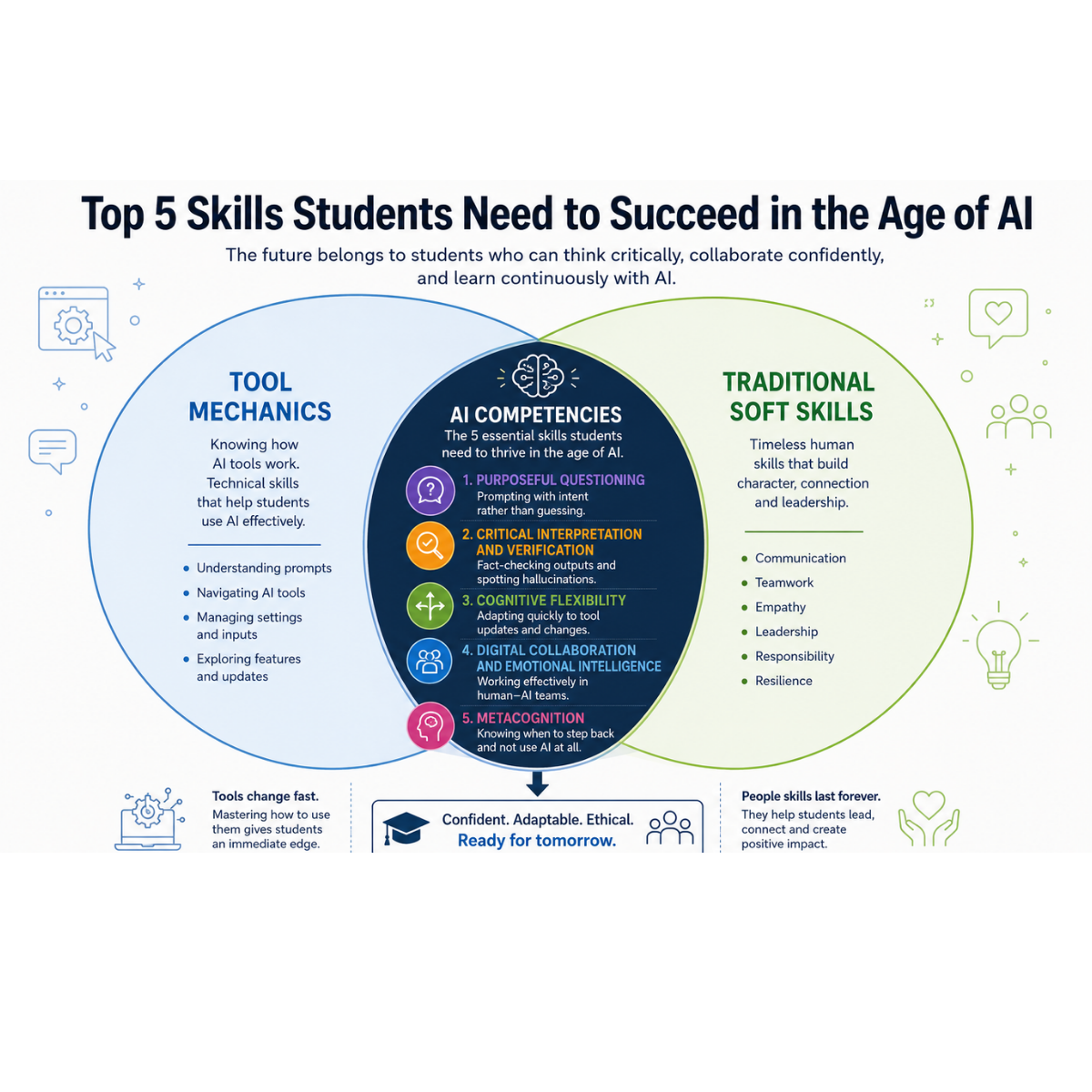
The five essential AI competencies sit at the overlap of tool mechanics and timeless soft skills.
1. Purposeful Questioning and Prompt Engineering
"I wrote the prompt though," your student confidently tells you when you ask them about their homework. Prompting AI tools might look like a simple job, but it goes by a simple rule that operates even in the classroom – a student asking a vague question will get vague answers.
Prompt engineering is one of the hottest must-have AI skills in the market these days. But behind all the technical bits, as important as they may be, lies the problem of communication – how well is the child able to articulate their enquiry to get the most out of AI? Are they trained to particularly pay attention to what they are putting in as a prompt and the answer they are getting? Are they purposeful about what they are asking, or just chatting mindlessly? These are some questions worth paying attention to.
As a simple example, compare two prompts on the water cycle: Prompt 1 asks the AI to "write an essay about the water cycle," and Prompt 2 asks, "I am trying to understand the water cycle. Ask me questions one by one on its various components to test my knowledge." You'd clearly be able to tell which one will actually help cement the topic in your student's mind and help them learn. The job is to instill the same understanding in students.
How to teach it: Incorporate prompt-related training into your built-in lesson plan instead of having a separate "tech" session. Have students compare one generic vs. purposeful prompt and guess the response of the AI.
2. Critical Interpretation and Verification
AI is not an all-knowing encyclopedia. Large language models operate on massive amounts of computational power and human data to predict the next logical word in a sentence. Because they train on our data, they also inherit our blind spots. A study by the UK government confirms that LLMs carry built-in structural biases, often presenting skewed viewpoints as objective reality.
They also have a habit of making things up, commonly called "hallucinations." On average, LLMs show a 20% tendency to hallucinate, which only increases as the topics they deal with get more complex. If a third grader learns to blindly trust what Gemini has to say about a constitutional right they should have a complete knowledge of, it will work to continuously deteriorate their ability to critically verify and evaluate any information the bot may present.
How to teach it: Have students act as editors. Give them an AI-generated essay containing intentional flaws and ask them to find the logic gaps and run verification steps on the sources.
3. Cognitive Flexibility and Tool Adaptation
A student who only learns the mechanics of the currently latest GPT 5.5 is setting herself up for failure when the technology upgrades by the next term and a brand new interface drops.
When new features are being introduced overnight and technological advancement continues with no limits in sight, a student who's rigorously fixated on mastering the current tool will panic when the layout becomes unrecognizable in a few weeks.
Here, cognitive flexibility and adaptability are skills that need to develop side by side, to the extent that adjusting when the system parameters change and tackling upgrades comes naturally to the student.
Fostering this adaptability is one of the critical skills leaders need in the age of AI. For example, a student might be used to typing text prompts, but suddenly they need to use multimodal AI to pull data from an image or a voice note. They have to figure out the new logic and keep moving.
This isn't limited to school learning, but even extends to a major skill recruiters seek in employees. Analytical and creative thinking remain the top skills for workers precisely because technology requires constant readaptation, the World Economic Forum recently highlighted.
TomoClub's AI Literacy program makes this adaptation seamless by embedding these core cognitive competencies directly into engaging, game-based scenarios, forcing students to adjust to changing variables in real time rather than just memorizing a tech interface.
How to teach it: Introduce a sudden constraint halfway through a project. If they were using an AI writing assistant, restrict them to only using an AI image generator to convey their remaining ideas.
4. Digital Collaboration and Emotional Intelligence
A valuable leader, employer, or employee of tomorrow needs to be empathetic, communicative and cooperative. The International Labour Organization (ILO) clearly outlines that emotional intelligence, teamwork, and conflict resolution are non-negotiable requirements for the modern economy in the age of artificial intelligence.
While AI can process massive datasets, run complex workflow automations, and even operate as autonomous agents that finish routine tasks, what it cannot do is read a room, build trust, or navigate the nuances of human relationships. Your students will be entering a workforce where they manage both human peers and AI agents side by side.
High EQ (emotional quotient) teams are known to manage stress, handle tight deadlines, and build relationships far better than those lacking these traits.
Therefore, when we talk about human skills in an AI-driven world, collaboration is at the very center.
How to teach it: Create a collaborative human-AI workflow where an AI first generates an idea, then an individual student reviews it, and then it passes on to a peer group where the idea is debated, discussed and modified before being finalized.
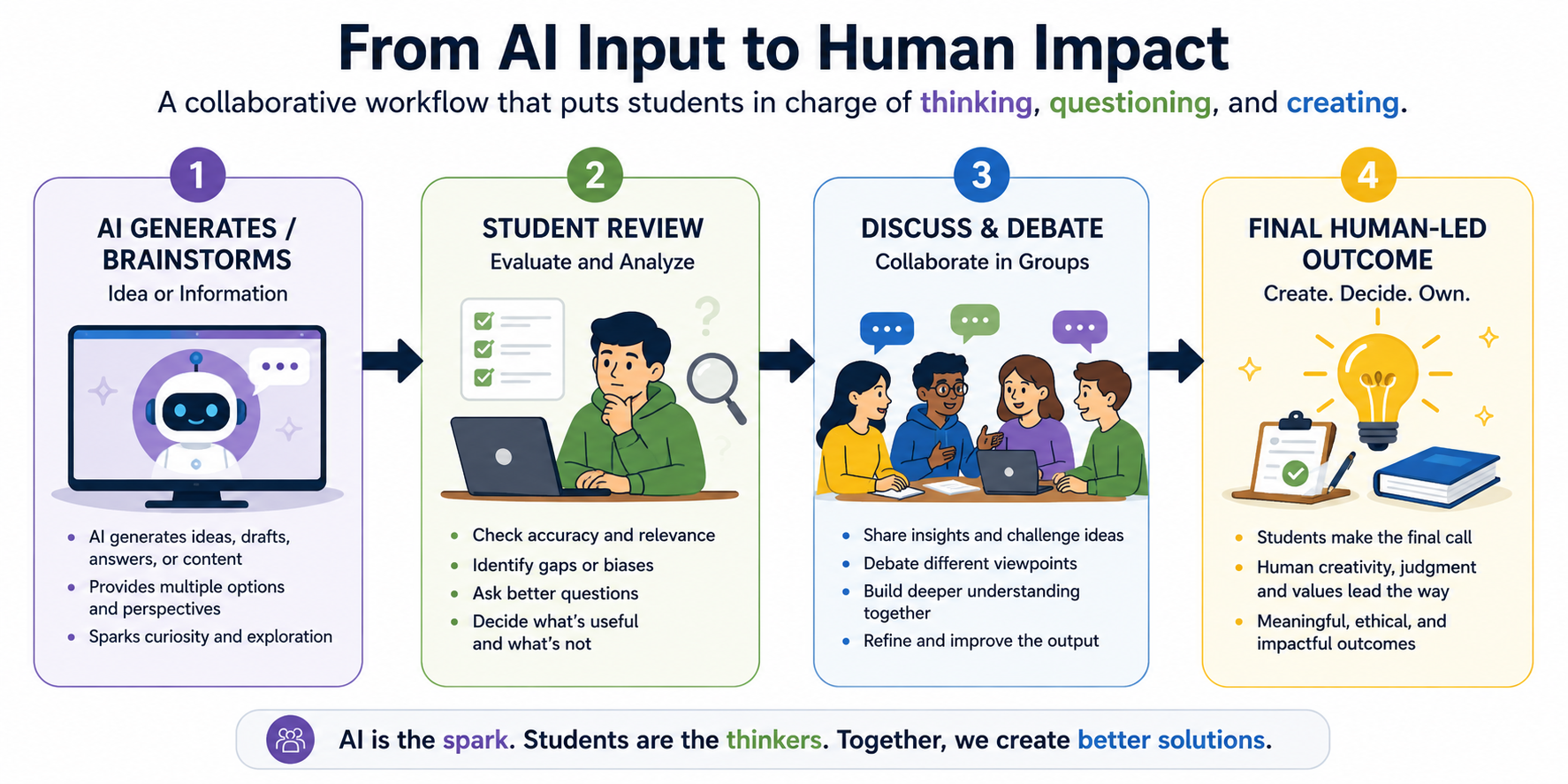
AI is the spark. Students are the thinkers. A collaborative workflow that puts students in charge of thinking, questioning, and creating.
5. Metacognition and the Judgment to Step Back
Finally, one of the most valuable skills a student preparing for an AI-driven future can have is metacognition. Metacognition involves thinking about your own thinking. A metacognitive learner can evaluate when an AI tool genuinely helps them brainstorm a complex framework versus when it just interferes or takes away from their own learning process.
However, an average middle or high schooler cannot be expected to automatically judge these boundaries. A simple way to do this is to make sure every assignment comes with clear expectations. AI assessment scales (ranging from No AI to Full AI) can give students definitive guardrails. It can help develop the self-awareness to recognize when an AI shortcut is actually detrimental to their growth.
How to teach it: Ask students to document their AI usage trajectory. Have them submit a short AI log alongside their final assignment detailing exactly how the tool was used as per the assessment scale. Ask them to record which parts of an AI response they accepted, which they rejected, and how they revised the final product to keep their own voice.
Preparing for What Comes Next
The conversation around education and technology is too often clouded by immediate anxieties over cheating or job replacement. But when we look past the panic, the mandate for educators becomes incredibly clear. Our job isn't just training students to push buttons or operate software. We are teaching them to maintain their critical edge when the software does the heavy lifting. The future skills and competencies that matter most are the ones that make us distinctly human.
To properly prepare your district, your school or your classroom for the future, you need resources that put these concepts into practice. That is exactly where TomoClub steps in. Our future-ready skills program simulates complex, shifting environments, actively pushing students to communicate, collaborate and creatively solve problems – skills that will carry them far ahead as individuals and leaders alongside technology.
We believe in helping you build a generation of resilient, future-ready students together, without adding another exhausting initiative to your teachers' plates.
Bring TomoClub to your school. Book a call →
Frequently Asked Questions
What are the top 5 skills students need to succeed in the age of AI?
The essential competencies for modern classrooms include: purposeful questioning (prompting with intent rather than guessing), critical interpretation and verification (fact-checking outputs and spotting hallucinations), cognitive flexibility (adapting quickly to tool updates and changes), digital collaboration and emotional intelligence (working effectively in human-AI teams), and metacognition (knowing when to step back and not use AI at all).
Given AI's impact on future job markets, should schools prioritize coding over soft skills?
Not necessarily. While technical understanding is highly valuable, industry leaders consistently emphasize that human traits, like empathy, strategic thinking, and complex problem-solving, are significantly harder to automate. Balancing digital literacy with strong interpersonal abilities is the most secure preparation for an unpredictable career landscape.
How can students thrive in an AI-driven world if the technology changes every month?
The secret is focusing on cognitive flexibility rather than tool mastery. When students learn how to approach problems analytically and pivot their strategies when constraints change, they can easily adapt to entirely new interfaces or software updates without falling behind.
How can teachers integrate these skills without burning out?
The most sustainable approach is to route AI skill-building directly through existing assignments rather than launching a separate technology class. The goal is to embed these competencies into the daily curriculum, to facilitate learning rather than have teachers constantly reinvent their lesson plans.