

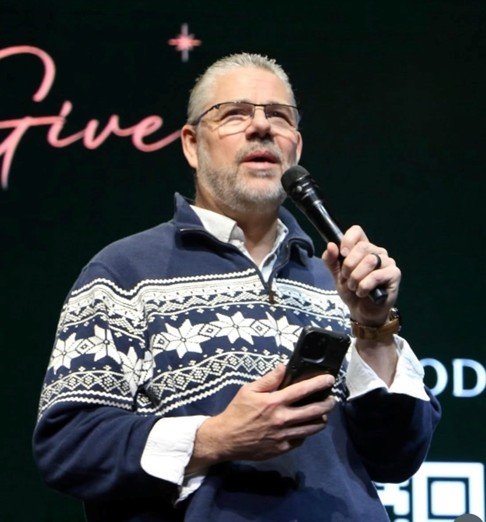
Dr. Ripley presenting at the Toddle AI conference
“We talk about innovation all the time. But the system itself is built to resist it.”
Scott has spent his career working inside that resistance. A former teacher and coach turned superintendent, he now leads the High Point Regional High School District in Sussex County, New Jersey, overseeing a comprehensive public high school serving grades 9–12 and a diverse community of learners.
Along the way, he has seen how deeply schools remain tied to a 19th-century factory model, one that sorts students early, protects adult comfort, and makes meaningful change slow, political, and costly.
For Scott, innovation isn’t about adding new tools or programs. It’s about questioning the structures that quietly decide who gets access to opportunity.
The Experience That Shaped His Belief in Students
Scott’s perspective didn’t come from theory. It came from experience.
As a student, he hated school. He felt invisible. He was told he wasn’t smart, that he had limitations he would need to accept. Learning didn’t feel expansive. It felt like sorting, like being quietly placed into a box and expected to stay there.

Everything changed later, in community college.
A professor didn’t look through him or reduce him to past performance. Instead, they believed in him.
“That belief changes everything,” Scott told us. For the first time, potential wasn’t treated as fixed. It was something that could grow.
What he experienced has a name: the Pygmalion Effect. When adults believe in students, students rise to the level of that belief. When they don’t, students internalize the ceiling placed above them.
“I believe it wholeheartedly,” Scott said. “When people believe in kids, they rise.” That belief reshaped how he defines the purpose of education.
“Our job as educators is to inspire kids to love learning and to love themselves.” Not as a slogan, but as a responsibility. Because systems either reinforce belief or quietly erode it.
Lorem ipsum dolor sit amet, consectetur adipiscing elit. Ut elit tellus, luctus nec ullamcorper mattis, pulvinar dapibus leo.
How Schools Quietly Gatekeep Rigor
As Scott stepped into leadership, he began to see a pattern. Education talks often about equity and opportunity. It speaks confidently about rigor and innovation. But when you look closely at how schools actually operate, access is often limited long before students get a real chance to try.
Many systems are still built around adult structures rather than student growth. Tenure rules, grievance processes, political pressures, and long-standing habits shape what happens day to day. Change doesn’t just require a good idea. It requires stamina.
And superintendents, without tenure themselves, carry that risk directly. “Change in education requires courage,” Scott said. “And very few people are positioned to sustain it.”
That reality became clearest in the way schools treated Advanced Placement courses. AP classes were presented as opportunities, but they often operated as filters. Prerequisites, recommendations, and tracking systems quietly decided who was “ready” and who wasn’t.
“Readiness became an excuse,” Scott said.
Students with IEPs were frequently excluded early. Students without strong advocates were filtered out along the way. Decisions about potential were made years before students had the space to grow into challenges. What was called rigor, Scott realized, was often less about high expectations and more about maintaining comfort within the system.
Who Decides Who Is Ready?
Removing Permission from Rigor
Holding the Line Under Pressure
When Access Expanded, So Did Outcomes
Changing Adult Mindsets
When Everything Becomes About Grades
The work didn’t unfold without tension from families!
Parents today are more involved than ever, but also more anxious and often divided in what they expect from schools. Some want their children protected from pressure and disappointment. Others want them pushed relentlessly toward achievement. In both cases, the conversation often circles back to grades.
“Grades distort learning,” Scott said. In life, failure is how we grow.
But in school, fear of failure can limit risk-taking and stretch. For Scott, leadership meant consistently reframing rigor as growth, not performance – and reminding families that challenge is not punishment. The pressure never fully disappeared. It was absorbed, navigated, and held steady in service of students.
What AI Is Exposing in Schools
AI isn’t simply another innovation to manage. It’s revealing where the system is misaligned with the world students are entering.
The Conversation Can’t Be Rewound
“You can’t put the toothpaste back in the tube,” Scott said. AI isn’t a trend schools can opt out of. It’s already embedded in how students learn and access information.
Resistance Is Understandable – But Limited
Some educators want to remove technology altogether. Others fear it will weaken academic rigor. But eliminating AI doesn’t eliminate the reality students live in outside school.
Personalization Is No Longer Optional
AI makes individualized learning scalable. It challenges rigid, one-size-fits-all models and pushes schools toward student-centered design rather than teacher-centered delivery.
The System Is the Real Constraint
AI doesn’t break schools. It reveals what was already outdated. Structures built for compliance struggle in a world that demands adaptability and critical thinking.
Alignment Becomes the Real Work
For Scott, AI isn’t about novelty. It forces alignment between what schools claim to value – growth, ownership, real-world readiness – and how they actually operate.
What Courage Really Looks Like
And yet, Scott stayed. “Schools aren’t a social welfare system for adults,” he said. “We’re here for children.” That clarity shaped his decisions when resistance grew loud and pressure intensified. Holding the line wasn’t about winning arguments. It was about staying anchored to purpose.
For Scott, the future of education isn’t mysterious. It is student-centered. It prioritizes access over sorting. It treats belief as foundational, not optional. AI may accelerate change, but it won’t replace the human core of schooling. Relationships, trust, and high expectations remain the real work.
Change is possible. But only if leaders are willing to stay long enough – and steady enough – for it to become part of the culture, not just another initiative.
Why TomoClub Is Sharing This Story
At TomoClub, we believe the future of education is shaped inside schools by leaders who are willing to question what no longer serves students and redesign systems around how learning actually works.
The Education Hall exists to surface these stories – not idealized case studies, but real leadership under real constraints.
Dr. Scott D. Ripley’s story reflects the kind of leadership education needs right now. Grounded. Student-centered. And courageous in ways that actually last!
